
Candidate Euridice Specification
Xt-EHR WP7.2 together with the IHE Radiology Technical Committee and the EURIDICE initiative (that brings together IHE-Europe and HL7-Europe) have been working on the Manifest based Access to DICOM Objects (MADO) Profile to produce an international version of the profile.
The draft MADO Profile (V 0.6) issued along with the Xt-EHR D7.2 Stakeholder Consultation (started early October and concluded on November 11th) has been improved and an updated draft IHE MADO Profile (V1.0) has just been issued by IHE for Public Comment until January 10th 2026.
IHE Public Comments are open to all, even if you are not an IHE-International or an IHE-Europe member. Please follow the instructions below to submit your comments, if any, before January 10th.

IHE Radiology Technical Framework Supplement
Published for Public Comment
The IHE Radiology Technical Committee has published the following new Technical Framework Supplement for public comment in the period from December 8, 2025 through January 10, 2026:
- Manifest-based Access to DICOM Objects (MADO) – Rev. 1.0 New! The document is available here. The IHE Radiology Technical Committee will consider comments submitted by January 10, 2026, in developing the trial implementation version of the supplement. Please submit your comments at Radiology Public Comments.
Xt-EHR WP7.2 intends to process the 46 comments related to the IHE MADO Profile, received as part of the Xt-EHR Stakeholder Consultation along with the comments to be received as part of this IHE Public Comment. The goal is to produce in February 2026 a IHE Trial Implementation version that will be included in the updated D7.2 output.
Reviewers should note that the specification of the FHIR-based Imaging Study Manifest that forms Chapter 6.X.2 is integral to the MADO Profile.
The EURIDICE Initiative and the IHE MADO Profile
The European Health Data Space (EHDS) requires robust, interoperable, and testable technical specifications. To meet this need, HL7 Europe and IHE-Europe have partnered to create the EURIDICE Initiative. This collaboration leverages the strengths of both organizations: the agility and community of HL7 FHIR and the established methodology and testability of IHE. The goal of EURIDICE is to take proposals and turn them into trusted, technical artifacts that are endorsed by both communities and can be proposed as specifications for the EHDS.
The MADO Profile in the context of EHDS and EURIDICE
The need for the IHE MADO profile has been championed by the Xt-EHR Project that is tasked with the scoping and the development of the EHDS specifications for the Exchange of Imaging Studies and related Imaging Reports. The IHE Radiology domain has agreed to further its development as an internationally adopted profile over the next few months. The current draft (V0.6), prepared by this joint IHE-Europe and HL7 Europe collaboration as EURIDICE, was part of the Xt-EHR project stakeholder consultation on the D7.2 Specification between September 28th and November 11th 2025. This is the draft for review of the MADO profile which was included in this review. It was the basis of the Public Comment version by IHE Radiology issued on December 8th, 2026 (see above). It is planned that the European comments and the IHE international comments will be jointly resolved to produce, by February 2026, a trial implementation version of the IHE MADO Profile ready for reference by the Xt-EHR released specifications in the spring of 2026.
Scope of the Manifest-Based Access to DICOM Objects (MADO) Profile
The Manifest-Based Access to DICOM Objects (MADO) is a new IHE profile for accessing DICOM instances based on an imaging study manifest. The MADO profile is designed to support a common and effective way to retrieve medical imaging studies, whether through existing or emerging standards.
While a similar concept was introduced almost 20 years ago by a part of the XDS-I.b profile, the MADO profile aims to create a second-generation solution. It provides a more precise and flexible approach that can be combined with various document sharing infrastructures such as those based on XDS or the newer FHIR-based document sharing profiles, like MHD/MHDS, which are critical for meeting the requirements of the EHDS regulation.
Two formats of imaging study manifest are offered alongside with the mapping between them:
- The DICOM KOS-Based Manifest format
- The HL7 FHIR-Based Manifest format
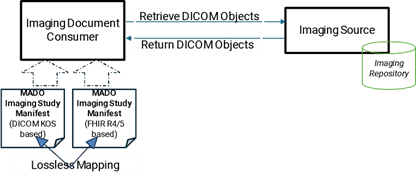
Based on the information and addressing information recorded in either manifests, remotely stored DICOM Objects are accessed through a specifically profiled DICOM WADO-RS based transaction thus allowing the user of the Imaging Document Consumer to benefit from the flexibility of adjusting the scope of access from the entire content of an imaging study, the content of a specific series, specific instances or only the imaging instances that may have been flagged as significant.